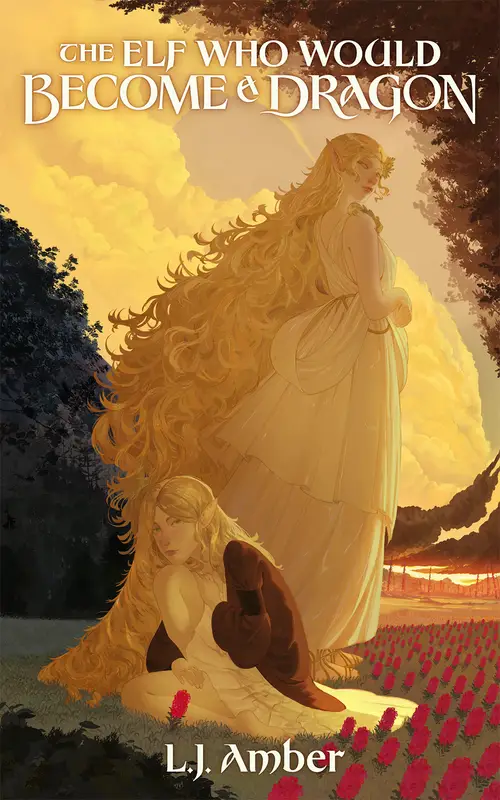
Character-driven elven tragedy with gorgeous prose and deep worldbuilding. A glacial slow burn, and not a power ladder.
Character-driven elven tragedy with gorgeous prose and deep worldbuilding. A glacial slow burn, and not a power ladder.
As of writing this review, I’ve read the completed story (150 chapters, roughly 3000 pages).
They made her conform. She made them regret it.
Saphienne lived the idyllic life of an elf in the woodlands. They told her she was loved; they told her she belonged; they told her she was superior to the aging, dying mortals. Eternal joy was to be her birthright, delivered by the supremacy of elven magic.
But Saphienne was a profoundly gifted child — and all gifts demand a price. The woodlands weren’t the paradise they seemed, and once she’d witnessed their hidden suffering she couldn’t look away.
Perhaps that was why she pursued an apprenticeship in wizardry, hurling herself against challenges both magical and moral. Saphienne would grow to become a formidable woman… and when the flames subsided, the elves would strike her name from history.
Come: listen to the story they don’t want you to hear. Behold Saphienne in her becoming. See her rise and fall, losing what she cherishes and finding what matters, and in the end?
Decide who she was for yourself.
The Elf Who Would Become A Dragon is a heartwarming and heartbreaking fantasy about rejection and belonging, power and consequence, and the cost of being ourselves.
Expect character-driven writing; fun but believable characters who grow over time; slow burn, slice of life drama with highs and lows; conflict with meaningful stakes; twists with satisfying conclusions; thoughtful and detailed worldbuilding; and an accessible, compelling story that has many layers — if you want to look for them.
Oh boy. Okay. So, I don’t see TEWWBAD often on tier lists (on Reddit), but when I do it’s almost always goated. So I figured I’d give it a shot. I have so many, many thoughts to try and squeeze into this review, so please allow me to scaffold them out. Let’s start on the basics central to progression fantasy (the book is tagged as progression) and then I’ll dig into what I loved and what I did not.
Worldbuilding is great. Sure, it would have been nice for more details outside the elven woodlands (which we should get in the author’s promised sequel), but within the elven woodlands there are thousands of years of history, of complexity, of interconnected relationships, and a societal mirror to explore. The elves effectively live in utopia. Life unending, pursuing their chosen arts, no currency, effective post-scarcity. But it’s built upon a layer of control and obedience to the ancient ways, and bowing to the societal consensus, which has fun things like non-elven lives being unimportant against the eternity of elven lives. 9/10.
Characters. There are many, and they are all deep. Their dialogue, their mannerisms, the patterns of language and prose and complexity of their thought are amazing. 10/10.
The plot obviously ties into the worldbuilding above, and what happens when someone does not and cannot conform to societal expectations. It’s about identity, and discovery, and power, and---above all else---tragedy. If you have read and loved Robin Hobb’s works, the plot is complex and enthralling. If you used to read such works and now read simpler progression fantasy with well-defined struggles, the plot is much slower to become compelling. Let me reaffirm the main point: this story is an unfolding and constant tragedy. Do not expect or want the common PF trope of the MC always winning or turning things around. Shit is sad and will remain sad.
Alright, so here’s where the contention starts.
Power and progression. Glacial. Saphienne is apprenticed to a wizard at age 14. Many of her lessons are philosophy and very dense, symbolism-laden thoughts and prose (I’ll touch back on prose later). The story is 150 chapters, 3k pages. Guess how long it takes her to cast her first spell? Whatever you think, it’s later. It’s exactly chapter 100. For a page-wise comparison, consider if Harry Potter had Harry doing complex philosophy to understand magic for all of The Philosopher’s Stone… and Chamber of Secrets… and Prisoner of Azkaban… and Goblet of Fire, and then in Order of the Phoenix, finally, he casts his first spell! That certainly would be something. So if you’re expecting the normal rapid progression many gifted MCs have in the genre, look elsewhere. Saphienne’s power and progression do increase towards the end of the series, but you have to be willing to read through a lot to get there.
Now the power system is deeply tied to understanding, art, and philosophy. Prose is beautiful, but also dense. To me (a well-read reader) it’s often unintelligible in its symbolism (admittedly I do struggle with this). Saphienne often has comprehension breakthroughs or realisations, but instead of them being explained the author loves to cut away and trust the reader to figure out what Saphienne did. Sometimes there are explanations. Most often there are not.
The answer would have filled her with horror, had her rage left any room.
What was the answer??
And if she was as antisocial as Hyacinth claimed, why had the younger spirit been tutored by–
The cold around Saphienne was as nothing compared to the black ice in her bones.
WHAT DID SHE REALISE?
…Except, Saphienne had a horrible feeling–
Lynnariel abruptly stopped.
Please…
As [redacted] answered, endless night became vivid green, verdant green, the colour of winter’s death and the first, most tremulous fingers of spring that reached and reached and–
Pleaseeeeee
which requires…”
“…Requires what?”
Disquieted, Saphienne pulled back from an insight she wasn’t ready to confront.
I’m ready to confront it! Give it to me!
Or was it possible that–
“I might have a theory about what’s to blame.”
WHAT WAS POSSIBLE?
Jorildyn had confirmed her suspicions.
WHAT SUSPICIONS?!
But he was mistaken. That wasn’t what–
“Saphienne?” Faylar’s call stole her attention.
I’m tired boss. I am too dumb to figure it out myself. My brain too literal.
Okay, some of the above, I’ll admit, are simply examples of cutaways and have their revelation quickly and explicitly explained. Many however, are not so neatly cut and dried. Judging from how other Royal Road reviews are split, there are plenty of people on both sides, with some finding it refreshing that the reader can fill in the blanks (and they as readers are able to do so) and others in my camp of smoothed brain.
So for me, and I don’t say this often, but maybe there could be a little more telling instead of this incomplete showing. I wonder how much more I would have engaged with the story had I known what was going on more than 20% of the time. It’s not just the constant cutting away from revelations, but the deliberate purpleness of the prose. Granted, sometimes it’s beautiful, but often at the cost of legibility. Here’s an example from a late chapter, some words redacted to ensure no spoilers. It’s the close of a momentous scene played out in an inner world of symbolism.
Apprehensive, allured, he crawled to her feet, staring up into spellcraft that augmented the [redacted] that was vessel for his [redacted], beholding then more than chaos in the fire she wielded like hammer and chisel, spying behind the lashing tongues his own self in his perpetual becoming.
Overcome by that harrowing freedom, he wept.
On one hand, symbolic and beautiful. On the other hand, I have no damned idea what it means, and my appreciation and enjoyment of what is meant to be a powerful moment is ruined by not knowing what is being talked about. Another example is this summary of what wisdom is by the MC, which comes up numerous times throughout the story:
“Society is founded upon that which proceeds from us that we each forbear to claim; wisdom is knowing what to forbear to claim.”
Haha, yes. Words. I am sure some people reading this review will read the above and understand the point being made. I don’t. I went to the comments to try and parse this in plain English to make sure my interpretation of the above made any lick of sense. These moments of confusion for me as a reader are constant and they add up into this roiling mass of “WHAT IS GOING ON” that underlies the whole story. I’ve given the story a B rank because of its strengths in characters, worldbuilding, and emotional depth, but I can’t help but wonder how much more amazing I would have found this story if I could actually follow more than some of it. What I really need is a socially inept, autistic side character that the MC could explain things to in dumbed-down English. Then, maybe, I could nod my head, smile happily, and penetrate the philosophical clouds that so heavily obscure the beautiful story underneath.
How to summarise? Philosophy majors who love tragedy and have the ability to easily understand symbolism may find this the best story they have ever read. Popcorn power-fantasy and power-progression readers wanting escapism will probably drop the story before Saphienne casts her first spell almost two thousand pages in.