Posthuman sci-fi where the MC has no system — he's trying to destroy it.
Posthuman sci-fi where the MC has no system — he's trying to destroy it.
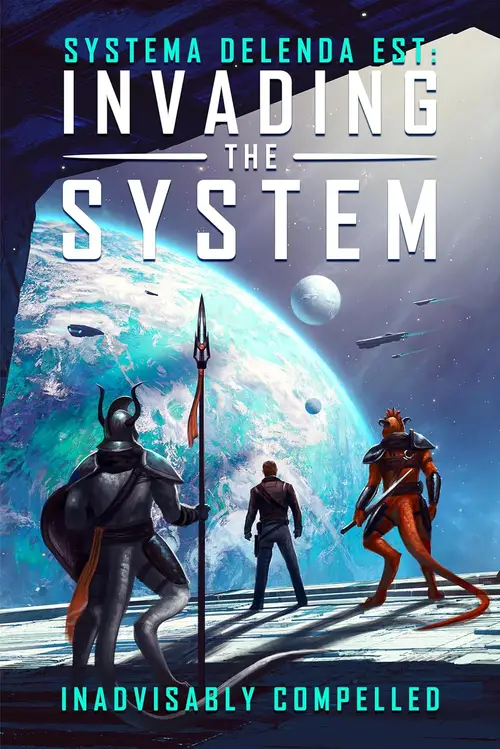
When the System came to Earth, technology failed, monsters appeared, and billions died as humans were inducted into the game-like physics the System enforced. Unfortunately for the System, not all humans were on Earth.
Some scattered postbiological individuals decided to push it back, and embarked on a decade-long crusade to eliminate the System from Earth. Cato is just an ordinary postbiological citizen, disgusted enough by the System’s excesses to go through one of the portals on Earth and spread himself to the broader System just as Earth is completely freed.
He has no magic — for the System can’t be destroyed from within — but he does have the technology and knowledge of a civilisation that is reaching toward the second rank of the Kardashev scale. Cato may have to operate under the System’s limitations, but he certainly doesn’t have to play by its rules, and fully intends to remove the threat it offers.
As of writing I’ve read the whole trilogy. And it’s finished, which is rare in the genre.
This story is in a bit of a weird genre subset. It’s effectively an ideological fight at civilisation scale, waged across decades and tens of thousands of worlds.
The premise is a genuine LitRPG inversion. Cato arrives in the System already at peak posthuman capability: a consciousness that can run as multiple simultaneous instances, be transferred into synthetic frames, spin up entire civilisations in accelerated simulations, lots of fun and inventive uses of technology. The levels and skill tiers everyone else grinds toward are useless to him by design (he’s not in the system). His power is industrial and exponential, not personal and vertical. If you want a zero-to-hero arc, this isn’t it. His is more a zero-to-galaxy-spanning-factory.
Where the series is genuinely exciting is the posthuman stuff. Consciousness sharding, reconciliation of diverged instances, the weird weight of meeting a copy of yourself who’s spent a decade making different choices. Earth pre-System had already developed “Summer Civilisations” (simulated realities running millions of times faster than real time, entire cultures rising and collapsing over a single season). There are Winter Civilisations too, but I don’t need to cover everything. The tech is strange and good and I want more of it.
The two companions are Raine and Leese Talis, Sydean sisters who Cato resurrects early on and converts to postbiological form. They’re independent personalities, but the story’s own logic eventually undermines them. Once there are dozens of copies of each sister scattered across hundreds of worlds, each accumulating their own experiences, the investment in any particular instance quietly drains away. It’s consistent with the premise and also kind of a bummer. You feel it happening and can’t really argue against it. It makes sense, but it also makes things a bit impersonal, if that makes sense.
Scope is the persistent problem. By book three we’re talking millions of worlds and centuries of elapsed time. There’s no room for cultural depth when every planet is a waypoint — individual races and societies get a sketch at best. The worldbuilding is broad by necessity, which means shallow by necessity. If you go in hoping for the kind of deep planetary culture you’d get from a story set on one world, adjust expectations. The focus is almost entirely on the posthuman conflict in its broadest sense.
There’s also a power-fantasy gap worth flagging for PF readers. Cato’s progression is: set up a manufacturing base, build fleets, copy himself again. It’s coherent but it doesn’t scratch the same itch as watching a character get stronger and beat harder enemies. He starts beyond the System’s magic and stays there. The satisfaction is more strategic than visceral.
Anyway, the moral angle is the most interesting part. Cato is effectively going around stripping magic from civilisations that have built their entire existence around it. The story does actually reckon with this---the pro-System arguments get sharper as the series progresses, and it’s not played as obviously correct that tearing all this down is good. Rather than having it be too complex an argument though, the revelation that the system is actively changing people’s personalities does help bring things back to black and white.
The books get better ratings the further in you go, which is about right. The opening is disorienting, the middle is where everything finds its footing, and by the end the ambition mostly pays off. Come for the posthuman philosophy, don’t come expecting the LitRPG hit.