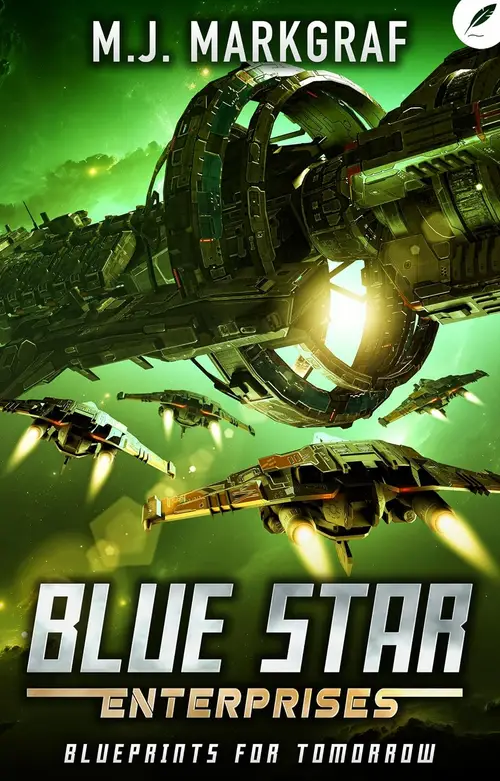
A sci-fi crafting and empire-building series about a man in a robot body growing a repair shop into a frontier enterprise.
A sci-fi crafting and empire-building series about a man in a robot body growing a repair shop into a frontier enterprise.
Trapped in a robot body on the galactic frontier, a man from Earth must build an empire to survive.
Every upgrade pushes Alexander closer to a power others would kill for.
On a dusty fringe station far from civilized space, Alexander scrapes by repairing the junk no one else will touch. The shop is a dead end, and his memory is fractured, yet each job sharpens instincts he can’t explain and reactivates dormant systems with capabilities no civilian machine should possess.
Alexander knows he isn’t built like any other robot, and someone has noticed.
A pirate lord has marked him for capture, convinced Alexander can build the war engines he needs to elevate his rag-tag fleet into an empire.
As Alexander unlocks the secrets within his damaged body, he’s thrust into a fight to protect the only people who’ve shown him kindness. He will have to rebuild shattered defenses, restore derelict stations, and reverse-engineer stolen technology to keep his new home alive and lay the first foundations of an enterprise that will one day shape the frontier.
As of writing this review, I’ve read the first two books on Kindle.
I picked this up after seeing a reddit promo post for book six and thought it would be a fun change from the fantasy-heavy works that dominate the progression fantasy and LitRPG genre. And yeah, this was a fairly chill read with a brain-in-a-robot-jar style protagonist that’s still getting their crafting base established and defended from corporations and pirates. The most similar comp to other series I’ve read would be Bobiverse, but obviously on a smaller scale and dealing with concerns (like refugees and drifters) which Bobiverse doesn’t normally dig into.
On its strengths, the crafting and the downtime are where the story shines. Alas, poor Alex rarely has enough downtime to do all the projects he wants, people keep trying to kidnap him! Or his adopted daughter. It’s a tough life, being an engineering genius.
Alex is just a top-notch guy. Kind, generous, guideless, naive, but just a beacon of positivity. So are his allies in general, those paragons of humanity. The antagonists are just as obviously not good people. For example, guess if this character (from their dialogue) is supportive or antagonistic towards Alex:
“If that scum-sucking shit ran off with my prize, I’ll scour the fucking galaxy until I find him, then I’ll flay him alive and string him up as a warning to others not to fuck with me!” he cursed.
Or perhaps:
“Greater?” his mom asked. “You were a mistake. A bad omen. I should have ended you the moment you were born.”
Characters are very black and white, which some readers will genuinely enjoy due to the simplicity it presents. It’s not as normal in a corpo-dystopian setting where people’s desperations, blackmailing, etc, allow for more shades of grey exploration (most famous example obviously being Cyberpunk2077).
Onto the worldbuilding, again it’s fine but again I think the setting itself could have used a bit more. There are some pirate factions, some corporations that interact with Alex, the STO (space government), and some far-distant aliens. However it feels like a lot of the fun implications of advanced tech (like cybernetics, etc) and how those have influenced cultures is a bit lacking. For one example, one of the space pirate factions (in the past) got orphaned in galactic space for a couple hundred years. How they developed could have been very special (see Belter culture and physiology changes from The Expanse), but instead the author went with:
“It could have been worse,” the man stated flatly. “Odin was with us. We had hull breaches in four areas and lost a dozen brave warriors. Their rites were performed, and we sent them to Valhalla to feast by Odin’s side.” “Praise the All-Father,” she responded automatically.
Vikings… in space. Nothing wrong with Vikings in space, I just don’t know how we got to this end point with the inputs given, which makes the setting feel less natural.
I suppose that’s a theme with the books, that there’s a lot of “This would be fun” and rule of cool with regards to how technology development works, manufacturing, how to keep the heat on Alex, worldbuilding, etc. To me it puts this in the more popcorn style read (where I’m not too worried about plot holes or consistency) rather than harder scifi. I’ve finished book two now and I’m tossing up whether I should pick up book three now or later, given I’ve also promised to read about a hundred other things. For those wanting a casual scifi crafting-focused read, you’ll probably enjoy this.
Oh! For a fun postscript, if the author ever reads this, you silly goose, you got atmospheric dynamics wrong!
“It depends on the planet you are on. On Eden’s End, the sky is a hazy yellow from the sulfur in the air. On most terraformed planets, I suspect it would be blue like Earth.
This is one of the more common things I’ve seen in sci-fi works. Sulphur is yellow. Venus has a sulphuric atmosphere. This atmosphere is yellow. Therefore, sulphuric atmospheres imply yellow skies. But what a foolish notion! Venus having yellow skies is because of how thick the atmosphere is, not sulphur. The same process (Rayleigh scattering) which makes our skies blue is what makes Venus’s skies yellow. Effectively, if you have a bit of atmosphere you scatter more blue light down, and we see blue. If your atmosphere gets thicker and thicker, you scatter blue so much that it gets absorbed and suddenly you’re blue-less and things are yellow. Any other physics people should be cringing at a few oversimplifications. Ignore those pedants, for I am the only one you need! So Eden’s End should have a dark blue sky based on its density and composition, rather than yellow. Legitimately not calling the author out at all on this, this isn’t a scientific paper and no one should read it as such, so please recognise the tongue-in-cheek tone for what it is. Anyway, on that fun and educational note, I shall desist.